Eco-friendly living for the practically minded.

Friday, July 16, 2010

Carrots!

To celebrate the carrots being harvested, we made roasted root vegetable. With garlic, shallots, carrots and herbs from our yard (our potatoes aren't ready yet, but our farmers market has them).

I pulled up 3 very normal looking carrots.
Then, there was this pair.
Heh heh. Dirty carrots.

Continue reading ...

Thursday, July 15, 2010

Wildlife

One nice thing about our rather haphazard garden is that we have a lot of wildlife. This is helped by our birdfeeder; we've counted over a dozen species at it and there's nearly always a few birds eating. But we've also provided a habitat that allows them all to make homes. Lots of high trees, lower, dense bushes, and good ground cover. We've also seen several small mammals: squirrels, chipmunks, moles, and a couple rabbits. We had one problem with a groundhog mowing on our parsley and peas, and we once had a green-tomato-eating racoon, but they've otherwise stayed away from the garden. I think (and hope) it's because we've provided them with preferable alternatives for food and shelter.

Anyway, we planted some sunflowers this year. I didn't get any pics of them blooming, but we left them on after the blossoms had died. I was originally thinking we'd roast our own sunflower seeds?
But someone else wanted them as well. He's so pretty, I decided that he gets them instead.
Later, he brought his girlfriend as well. I like how she's hanging upside down in this pic.
The goldfinches are rather messy eaters, leaving plenty around for our chipmunks.
There's definitely something nice about a garden with wildlife. It's always sad to me when I visit California. Everyone has big expansive lawns, but there's few trees or bushes. A few annuals here and there, but nothing is allowed to go to seed and feed the wildlife. Heck, there's even HOAs that will forbid it. I just find it very sterile. What's the point of having land if it's not going to be used? Just to show that you have enough money to support that amount of land and maintain it? (I wish there was a better word than maintain. I consider my garden maintained, but many would consider it rather wild. It is in fact maintained daily though. Manicured?)

My neighbor put it rather well the other day. We were ripping out some lawn between our houses for the roses and strawberries, and we asked him if it was ok since it's partially on his property. He said "Grass is the stuff between vegetables and flowers".

Continue reading ...

Monday, July 12, 2010

Taking the train in California

The last time I visited California, we flew in (as usual) to the bay area. Now, my parents live in the valley, which usually means renting a car and driving down to visit. It's about a 3.5 hour drive from my in-law's house to my parents' house.

Last time, driving wasn't really feasible. Saul needed to stay in Mountain View, which meant I would have to drive alone both ways. It was also going to require some backtracking in order to meet with some friends in Sacramento No fun at all. So at my parent's suggestion, I looked into the train.

End result: I took the train from Fremont to Fresno, then Fresno to Sacramento a few days later. It was fantastic, and we are now taking the train on every trip like this (which happens at least twice a year). The pros and cons.

Cons:

  • Very few trains. Like, there was only two trains each day from Fremont to Stockton (a transfer hub). At 4pm and 5pm. If you want to come back to Fremont, well, your SOL. The trains only go from Stockton to Fremont in the morning hours, which meant I couldn't possibly take the train from Fresno back to Fremont. This is a one way trip only.
  • Very few trains again. There's a train that goes from Fresno to Sacaramento. Direct, no transfers. Unfortunately that train only goes at certain times of the day. The other times, there's a train that goes to Stockton, but then you have to get off and take the bus to Sacramento. Now, there were so many people doing this, they had two buses. Why exactly can't we just have the train keep going? It would have been full!
  • The website is pretty terrible.
  • Any European taking the train would laugh at us. Stockton, the primary hub, has only one track next to the loading area. This means that if two trains come in at once (which happens a lot), one train parks in the middle of a multi-lane boulevard. All traffic is shut down, the conductor opens a single door, and passengers walk into the middle of an intersection to board the train. It was pretty funny. And the Europeans would probably find it pretty backwards and hillbilly.
But there were many many pros:
  • Only had to arrive 10 minutes before departure, and that was only so I could print my ticket.
  • No checkin lines.
  • No security lines.
  • No gate loading lines. I waited 2 minutes because an elderly passenger was having trouble on the stairs.
  • Legroom! Oh my was there legroom!
  • Everything is a carry on.
  • Power for my laptop.
  • Wifi on the commuter trains.
  • And on non-commuter trains, I could usually wardrive (wartrain?) at station stops long enough to send and receive email.
  • Enough space to actually use my laptop. With tables and everything! The seats in airlines have become so cramped that I can't even open up my laptop.
  • Cheap. My ticket across California cost $90, roundtrip. It would have been cheaper had I purchased in advance and been able to use my student discount. Certainly cheaper than either flying or renting a car.
  • Fast. If you take the train through the central valley, it goes the same speed as driving.
  • Food that is cheap and tastes reasonable. Even real-sized beer!
  • No crying children. The babies are all zonked out from the rocking, and the older ones are all fascinated.
  • My ears don't pop.
  • No seatbelt signs. Feel free to get up and move around the cabin. Heck, go over to the other cabin. Do a jig. There's even a dining car with more tables, in case you want a different table style.
  • No problems with liquids, swiss army knives, or knitting needles.
Total time from Sacramento to Fresno, via train: 3 hours. Driving time is about 15 minutes less. Works for me!

Continue reading ...

A yummy rose hedge

Lots to post about recently!

First, we finished the rose hedge a couple weeks ago. The goal is to hide my neighbor's death mobile.
Oh, but what's that under the roses?Let's get a closer look at that....
Mmmmm....strawberries....

We found out there's actually two kinds of strawberries: June-bearing and ever-bearing. Most commercial growers plant June bearing since it's better for harvesting (all fruits ripen at once). However, since we don't use our berries for pie and prefer to just snack on them, we have ever-bearing. We've been getting about 2 berries a day so far. Hopefully next year, they'll be more established and we'll get a few more!

Weirdness we discovered: it's very important to make sure the berries don't sit on the ground. Otherwise they rot and the bugs get them. Instead, we've been carefully propping up ripening berries on the leaves of a neighboring plant. This seems to fix it.

Continue reading ...

Monday, July 5, 2010

Curing garlic and shallots

I harvested the garlic and onion today! For all their gourmet-ness, these are both lazy-gardner's plants. We planted the garlic last November by shoving several cloves in the ground. (I use "Russian Red" because it stores well and has a nice strong flavor. I'm sure storebought works too, but if you're going to plant it, might as well getsomething strong!) We then completely ignored it. It popped up in early spring, out of the snow, and started going from there. We planted the shallots in spring, and then also ignored them.

So, both got nice and huge, and then started yellowing just before the 4th. Traditionally apparently, one harvests these on the 4th, and they looked ready, so we did!

This was our first year with shallots. They grow like onions, but in little bunches. Each shallot is about the size of a baby onion.
Saul planted about 10 shallots. Each shallot bunched off loads of babies, and we harvested over 70 shallots!
So, the "curing" thing. This is the one not-lazy part of these plants. Apparently you don't just pull them up and put them in storage. You have to encourage a nice protective layer of papery skin across the top so they don't rot. So, you set them out, tops and roots and all, in a warm and partly-sunny place to "cure". Once they're mostly dry, it'll be time to braid them and store them. So, out on the porch they go.
That's 17 garlic plants by the way. We went a little overboard this year....again. But on the other hand, we can always give them away, and I really like the garlic scapes we get from all of them in June.

Of course, the biggest ones we won't actually store. Those go in a separate space, to be planted in the fall! Best part about these plant: I don't have to order more plants or seeds ever again, and I don't have to baby any seedlings.

Continue reading ...

Saturday, July 3, 2010

Nitrogen-fixing Bacteria

I recently had a conversation with the Google crowd about how legumes are "nitrogen-fixing". A bacteria grows on their roots in a symbotic relationship, and it converts nitrogen (N2) into a form that plants can actually use (nitrate, N03-). (http://en.wikipedia.org/wiki/Nitrogen_fixation)

I had read that the bacteria forms small pink nodules on peas. Last year, I tried to find them, and couldn't, so I assumed they were rather small.

Imagine my surprise when I pulled up my peas this year.
Not exactly small. The largest are about the size of a nickel. I also wouldn't really describe them as "pink", more like a buff color.
Coolness. Chemistry in the backyard. No need to fertilize this garden.

Funny enough, this is why, back in the day, clover was a good thing to have in a lawn. You wanted clover in lawn, so that way it would add in nitrogen. Clover was even standard in lawn seed mixes.

Then the idea of fertilizer came up. How do you get people to buy fertilizer? Well, you do some awesome marketing to convince people that clover is bad. You convince them that a good, healthy lawn has only grass. Clover is a weed. How do you get a lawn like that? Buy our expensive fertilizer! Of course, since only the rich can afford this, we now associate lush, grass-only lawns with wealth. Which means everyone wants one. Fantastic.

I claim that my clover-spotted lawn is vintage, thank you very much.

Continue reading ...

Wednesday, June 30, 2010

Peas are crazy big

Well, Saul and I just ripped out the peas last weekend.This year, we decided not to tie them up. Normally, they look like this:


Kinda insane. Actually, this was more of a "we're lazy and we spent a lot of time away this season" decision rather than a thought through one. We came back from a week in the bay area to find that the plants had reached the top of a 3 foot lattice, gone 3 feet past that, fallen over, and grown back up again. While some vines were bent, it really didn't seem to hurt the plants, and actually made it easier to harvest!

Continue reading ...

Tuesday, June 29, 2010

Local Brews

Maja has reminded me that I haven't posted in a year! OMG, someone reads my blog!


So, here starts more posting. :)

First up: I just found out about this awesomeness happening at Construction Junction. Let's call it a Pittsburgh Oktoberfest.

A nice thing about living in Pittsburgh: lots of local breweries. Getting local produce in the winter is tough, but local beers? Always a good selection. Among those appearing will be:
  • The Church Brew Works
  • East End Brewery (which is like two busway stops from my house)
  • Erie Brewing Company
  • Fat Head's Brew
  • Great Lakes Brewing Company
  • Rivertowne
  • Penn Brew
  • Sprague Farm
  • Tröegs
  • Weyerbacher
Also? It's either a 30 minute walk to my house, or a 20 minute walk and bus. So no arguing about who is DD. I suggest all you yinzers get back into town for this one. It will be awesome.

Continue reading ...

Friday, June 12, 2009

sewing machine: HUGE SUCCESS

Do you see a hem on these pants? No? Good, because I have successfully used my new sewing machine to blind hem these suckers. Take that Martha. (Ok, so there's a line where I need to iron, but I did get the hem right!)


For the purpose of reusing clothes (and making new ones when I dislike the current fashions), I have purchased a sewing machine. Actually, my mother purchased me a sewing machine. (Thanks Mom!) Now that I have successfully done a reasonably difficult hem with it, it's time to go on to new, easier projects.

First up on the save-the-world-with-simple-stuff list: cloth napkins, kitchen towels, and other mess cleaners. We've already put the paper towels in a cabinet and use cloth IKEA napkins for non-toxic messes. But we've had a lot of friends over recently, and I realized we don't have cloth napkins. So we've been using paper napkins because the cloth towels we have are for dirty messes, not for wiping hands and faces with. So I'm going to try making some cloth napkins for next time!

Continue reading ...

Monday, June 8, 2009

My camera works again!

I hadn't posted for a while as my camera wasn't loading pictures onto my computer. I finally figured out the problem though; it seems there is something wrong with the cable. Here's the weird deal though: it works fine on Saul's computer, just not mine. But when I switched cables, it worked. So whatever.

Anyway, just found this on the camera. The culprit is in the lower right.


And this one was just cute.


Continue reading ...

Tuesday, March 24, 2009

Preserving herbs, results from winter

Well, I did learn a little more about this. Parsley, oregano, thyme, and basil all dried well. I tried drying on the branch and off the branch; off branch was better. Somehow it was more colorful and flavorful. Plus, they dried faster.

Don't dry chives though, they were terrible. I've realized it's not worth it anyway, they were still growing in the snow and they came back over a month ago. (And with a vengeance, too...anyone need chives? I have like 7 plants now.) I was only without for a couple months, so no big deal.

Continue reading ...

It's Spring!

Ten days ago, we walked outside and crocuses were blooming! I declared it the beginning of spring and spent the next weekend planting peas, lettuces, and spinach. My neighbor says the timing was perfect; according to her, all of those are supposed to be planted on St. Patrick' Day. Nothing has germinated yet, but I'm hopeful. I think it's partly because I'm not watering it enough; you would think that it would have rained, but it hasn't really yet.

I am also not going to have too much lettuce this year. Really. I split seed packets with Emily, Kami, and Michael, so I only have .... 400 lettuce seeds....ok, I'm still going to have too much lettuce.

I'm always surprised at how depressed I am in winter and how much happier I get when we finally have some sunlight and weather above freezing. One of my neighbors was laughing because he still considers it winter right now, and I was out flipping the compost pile, raking leaves, and planting! I did try to prevent planting too much this year though. I'm spacing out the lettuce, and there are no radishes this year. That should help some.

Continue reading ...

Thursday, September 11, 2008

Reducing waste

The bloggers at enviromom did a great series on reducing the amount of household waste we produce. They have a challenge to reduce your waste to only one can a month. Actually, Saul and I are pretty close already, but there's only two of us. We end up putting out a can every other week, so there's room for improvement still.

Anyway, what's really nice is that they've gone room-by-room in a typical house, listing ways to reduce waste in each room.

http://www.enviromom.com/getting-to-one-garbage-can.html

I'm thinking about requesting that Edgewood borough put this in their monthly newsletter. Besides the environmental effects, our taxes could be much lower if people didn't produce so much waste. Two of my neighbors, both just couples, somehow produce four trashcans of waste every week. How they do that, I'm not sure. I hear one of the couples has all of their dogs paper-trained, so they toss out lots of no-longer-recyclable paper. Not sure what's up with the other couple though.

Continue reading ...

Friday, September 5, 2008

Preserving herbs

Maja asked me about preserving herbs, specifically, freezing v. drying. So, a little late, here's what I figured out.

Last year, I tried freezing some herbs. There seems to be two methods for doing this:

1) Chop and freeze in a bag
2) Place in water and freeze in an ice-cube tray.

I tried both. #2 was pretty bad. Basically, the herbs float to the surface before they freeze, and then they get freezer burned. #1 was ok, but you can't measure it out. Basically, as soon as they thaw, they turn to mush, so you have to put them directly into the soup or whatever.

So, I'm just drying this year. However, I think it works best if you dry the leaves whole, and then crush them later as needed. I think it preserves the scent better.

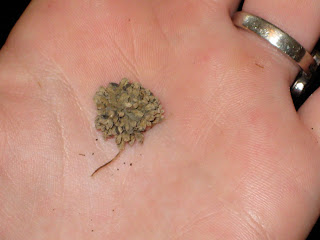
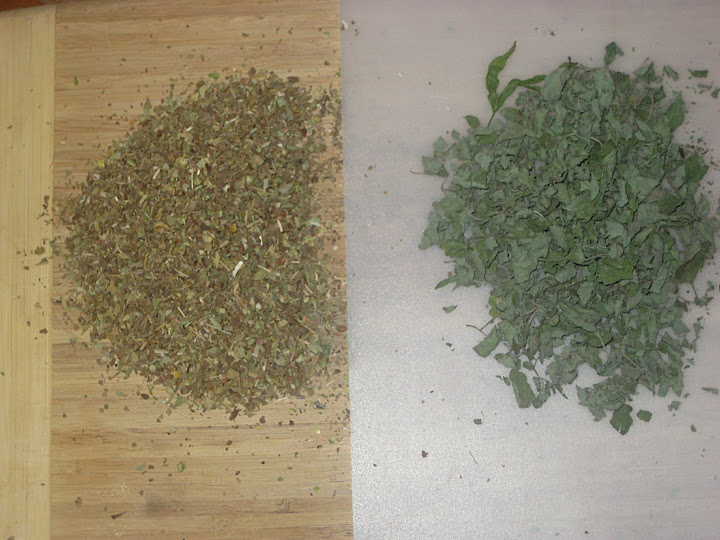
Unfortunately, you can't smell how amazing my dried parsley is, but here's the photo comparison of the store-bought parsley with my parsley.

Store bought parsley smells faintly of parsley, but mostly of "dried plant". Home grown parsley is the second strongest herb we grow. Saul put some in soup yesterday, and when I walked in the kitchen, that was all I could smell.

Continue reading ...

Monday, September 1, 2008

Sustainable cleaning

This book lists home-made cleaning products and a few safe store brands. They've got a cost comparison to the name brand cleaners, and they rate the effectiveness compared to the name brand. My favorite so far is the window cleaner. She suggests club soda, with a little blue food dye so that the house cleaner will actually use it. It works well, leaves no streaks, and doesn't smell like vinegar.

Clean House, Clean Planet


I've found a few other, more recently published books, but this one still seems to be the most comprehensive.

Continue reading ...

Thursday, August 14, 2008

Well, hello there

We found this in the garden.

That is a very LARGE tobacco hornworm. This explains why I kept finding half-eaten green tomatoes on the top of my plants. I think this one guy was doing all the damage. As big as he is, he was really hard to see. I only found him because he was ON the tomato I intended to pick.

I scoured the tomatoes, but found no others. We did have one last year, but it was smaller and covered in wasp eggs (yay for companion gardening!) I planted flowers that attract a particular wasp that kills these worms, and with the exception of this guy, it seems to be working.

He's nearly ready to become a moth, so I didn't have the heart to kill him. I just put him on the other end of the yard with a pile of fallen green tomatoes that he could eat for a day or two.

Continue reading ...

Tuesday, August 5, 2008

The danag

So, I'm not even sure how to transliterate "danag" properly, but pronounce it how it sounds. It's an Armenian word (actually, it might be Turkish, or just some random word my grandmother made up. See story about this below.). It means, loosely, washcloth. Specifically, during my childhood, it refers to the reusable washcloths that are usually pink, blue, or yellow, are very thin, but soak up lots of water. Refer to picture. Danag:


Anyway, I love these things. First, they are immensely resuable. They're ideal for soaking up large amounts of liquid or wiping down the table and counters. They're also great for dusting and general cleaning. Unfortunately, they're hard to find. Rite-Aid seems to stock them, and sometimes Giant Eagle has them in strange places.

I do sometimes still grab for a paper towel when I should use these. To help get me in the habit, I've made the paper towels harder to access. I've Put the paper towels a cabinet and put a couple reusable wipes in an easy-to grab place. One on the kitchen sink, and one hanging over the stove bar maybe. I've only once thrown them out because they ripped. Most of the time, they get tossed because I used it to clean up something really dirty. I haven't tried throwing them in the wash yet though, so I might try that sometime and see if I can get more out of them.

Random story about danags

One day in my apartment in SLO, my roomie was cooking dinner, and I was in the kitchen clearing the table. We had been doing projects on it, so it was a little dirty. I decided to wipe it down for dinner. So, I turn to my roommate, who is near the sink, and say "Hey Jen, can you hand me the da-" and it hits me. She's not going to know what a danag is. Danag is Armenian. No problem. English. Jen, hand me the what-the-hell-is-that-thing. Thingy. Cleaning thing. Washing thingy. Wipey-downy-thingy. Meanwhile my mouth is open and my roommate is staring at me and my brain basically just seg faults right there. Nothing except my mouth slowly opening and closing.

Anyway, after my brain rebooted, my ego recovered, and I recovered the item in question, I had to ask my roommate what it was called. She looked at me like I was nuts. "Uh, washcloth? What the hell is wrong with you?"

It occurred to me that for 18 years, my mom had been saying "Ciera, take the danag and wash down the table", "Ciera, hand me the danag", and "Ciera, wipe down the patio chairs; I left the danag outside". My dad even uses the word since it wasn't an item he grew up with, so he adopted my mom's vocabulary.

Worst brain fault ever.

Continue reading ...

Thursday, July 31, 2008

Petroleum-based chemicals in cleaners

Something I learned recently: most detergents contain ingredients based on petroleum. This includes most laundry detergent, dishwashing detergent, and fabric softener. Of course, the companies aren't required to list ingredients, so it's not like you'd notice easily. The other ingredients are also toxic and not bio-degradable. More info here.

So, here's the breakdown of alternatives:

Laundry detergent: There are non-petroleum brands out there. We use Seventh Generation, and I've found it to be pretty good. I haven't noticed any difference at least. Giant Eagle also carries it, so it's easy to get. Watch out though. Tide is marketing something called "Pure Essentials" that is still petroleum based. It sits next to Seventh Gen on the shelf. Clever marketing by Tide....

Fabric softener: From what I can tell, there are no alternatives here. Both sheets and liquid are made from petroleum. We just stopped using it entirely when the last bottle ran out. Honestly, I don't notice any major difference.

Dishwashing detergent: There are non-petroleum options. We tried them. Unfortunately, if you have really hard water, they don't work so well. They somehow left the dishes dirty. Apparently they work best with soft water. They probably would also work better if you pre-rinse, but we don't. So, we went back to the old stuff for now. I'm not totally happy about it, but one step at a time I suppose.

Continue reading ...

Monday, July 28, 2008

Apartment composting

Let it be well understood that I have not tried any of the following mechanisms myself...

So, without your own happy compost pile, this seems like a pretty hard problem. From what I understand, throwing food scraps in the garbage does not allow them to degrade. They get put in a rather toxic dump where any insects can't really survive well, and there may not be enough oxygen or water to support the bacteria needed.

I've heard of two things you could try if you can't have a compost pile or a fancy compost bin:

In-ground composting
Under this method, you use a kitchen container (like this one) to store scraps for a few days. Then you go outside, anywhere, and dig a hole. Dump in your scraps, cover back over with dirt, and let it be. Bugs will do the rest.

This is supposed to be ideal for people with small yards, bad soil, or home associations that don't allow composting. It's also a great way to make the soil better with little work. If you're in a small apartment building, I bet you could just do this on the property and no one would care.

If raccoons become a problem, apparently covering over the space with a brick for a week works. Then you just move the brick each week when you dig the new hole.

Vermicomposting
This is worm-based composting. As in, you have a box, and you keep pet worms. You feed them all your food scraps and you provide them with a nice "bedding" material. If done properly, there isn't supposed to be any smell, and the resulting soil is extremely fertile and would be good for houseplants. More info about doing this in an apartment!

Honestly, I'd get too busy and forget about them. Maybe they aren't much work, but given how the litterbox smells right now, I don't think I could handle a box of worms...if someone tries this out, let me know! I'm curious whether this is actually doable and reasonable. Given the number of sites that turn up when I search for "worm bin", I suppose quite a few people are going for it, so maybe it's easier than I'm expecting.

Continue reading ...

Composting

Lizzi asked about composting. I'll post first about what we do, and then about some things I've heard you can do in an apartment situation. So here's my compost mechanism:


What do you mean you don't have a 120 gallon aquarium with a 5 pound garbage disposal with claws and a fondness for biting fingers?

Ok, in reality, Terabyte gets first pick of the veggie scraps, but the rest go into the compost pile. We have a little can in the kitchen which stores the scraps up for a few days, then we dump it outside. This is particularly handy in winter when we don't want to go outside everyday to add scraps.


You'll notice we're pretty lazy composters. No fancy rotating bins for us. No adding worms, no thermometers and water gauges. We dump stuff on, and fancy that, it composts. My neighbor seemed kinda surprised by this concept. :) Once in a while, we turn it, and when we water the garden, we add some water to the pile. Based on the size of our worms, we're doing ok.

To prevent it from smelling, we just add only veggie scraps and yard waste. As long as you don't add any meat or sauces or anything beyond plant matter, it's fine. There's a fair amount of dirt in there, and we turn it every couple of weeks to get the scraps to the inside of the pile and bring the dirt on the top.

We also try to keep a 50-50 mix of greens(fresh plant matter) to browns(dried leaves). Supposedly this is a good balance for soil, but I think it also prevents it from smelling.

Continue reading ...