Eco-friendly living for the practically minded.

Showing posts with label garden. Show all posts

Friday, July 16, 2010

Carrots!

To celebrate the carrots being harvested, we made roasted root vegetable. With garlic, shallots, carrots and herbs from our yard (our potatoes aren't ready yet, but our farmers market has them).

I pulled up 3 very normal looking carrots.
Then, there was this pair.
Heh heh. Dirty carrots.

Continue reading ...

Thursday, July 15, 2010

Wildlife

One nice thing about our rather haphazard garden is that we have a lot of wildlife. This is helped by our birdfeeder; we've counted over a dozen species at it and there's nearly always a few birds eating. But we've also provided a habitat that allows them all to make homes. Lots of high trees, lower, dense bushes, and good ground cover. We've also seen several small mammals: squirrels, chipmunks, moles, and a couple rabbits. We had one problem with a groundhog mowing on our parsley and peas, and we once had a green-tomato-eating racoon, but they've otherwise stayed away from the garden. I think (and hope) it's because we've provided them with preferable alternatives for food and shelter.

Anyway, we planted some sunflowers this year. I didn't get any pics of them blooming, but we left them on after the blossoms had died. I was originally thinking we'd roast our own sunflower seeds?
But someone else wanted them as well. He's so pretty, I decided that he gets them instead.
Later, he brought his girlfriend as well. I like how she's hanging upside down in this pic.
The goldfinches are rather messy eaters, leaving plenty around for our chipmunks.
There's definitely something nice about a garden with wildlife. It's always sad to me when I visit California. Everyone has big expansive lawns, but there's few trees or bushes. A few annuals here and there, but nothing is allowed to go to seed and feed the wildlife. Heck, there's even HOAs that will forbid it. I just find it very sterile. What's the point of having land if it's not going to be used? Just to show that you have enough money to support that amount of land and maintain it? (I wish there was a better word than maintain. I consider my garden maintained, but many would consider it rather wild. It is in fact maintained daily though. Manicured?)

My neighbor put it rather well the other day. We were ripping out some lawn between our houses for the roses and strawberries, and we asked him if it was ok since it's partially on his property. He said "Grass is the stuff between vegetables and flowers".

Continue reading ...

Monday, July 12, 2010

A yummy rose hedge

Lots to post about recently!

First, we finished the rose hedge a couple weeks ago. The goal is to hide my neighbor's death mobile.
Oh, but what's that under the roses?Let's get a closer look at that....
Mmmmm....strawberries....

We found out there's actually two kinds of strawberries: June-bearing and ever-bearing. Most commercial growers plant June bearing since it's better for harvesting (all fruits ripen at once). However, since we don't use our berries for pie and prefer to just snack on them, we have ever-bearing. We've been getting about 2 berries a day so far. Hopefully next year, they'll be more established and we'll get a few more!

Weirdness we discovered: it's very important to make sure the berries don't sit on the ground. Otherwise they rot and the bugs get them. Instead, we've been carefully propping up ripening berries on the leaves of a neighboring plant. This seems to fix it.

Continue reading ...

Monday, July 5, 2010

Curing garlic and shallots

I harvested the garlic and onion today! For all their gourmet-ness, these are both lazy-gardner's plants. We planted the garlic last November by shoving several cloves in the ground. (I use "Russian Red" because it stores well and has a nice strong flavor. I'm sure storebought works too, but if you're going to plant it, might as well getsomething strong!) We then completely ignored it. It popped up in early spring, out of the snow, and started going from there. We planted the shallots in spring, and then also ignored them.

So, both got nice and huge, and then started yellowing just before the 4th. Traditionally apparently, one harvests these on the 4th, and they looked ready, so we did!

This was our first year with shallots. They grow like onions, but in little bunches. Each shallot is about the size of a baby onion.
Saul planted about 10 shallots. Each shallot bunched off loads of babies, and we harvested over 70 shallots!
So, the "curing" thing. This is the one not-lazy part of these plants. Apparently you don't just pull them up and put them in storage. You have to encourage a nice protective layer of papery skin across the top so they don't rot. So, you set them out, tops and roots and all, in a warm and partly-sunny place to "cure". Once they're mostly dry, it'll be time to braid them and store them. So, out on the porch they go.
That's 17 garlic plants by the way. We went a little overboard this year....again. But on the other hand, we can always give them away, and I really like the garlic scapes we get from all of them in June.

Of course, the biggest ones we won't actually store. Those go in a separate space, to be planted in the fall! Best part about these plant: I don't have to order more plants or seeds ever again, and I don't have to baby any seedlings.

Continue reading ...

Saturday, July 3, 2010

Nitrogen-fixing Bacteria

I recently had a conversation with the Google crowd about how legumes are "nitrogen-fixing". A bacteria grows on their roots in a symbotic relationship, and it converts nitrogen (N2) into a form that plants can actually use (nitrate, N03-). (http://en.wikipedia.org/wiki/Nitrogen_fixation)

I had read that the bacteria forms small pink nodules on peas. Last year, I tried to find them, and couldn't, so I assumed they were rather small.

Imagine my surprise when I pulled up my peas this year.
Not exactly small. The largest are about the size of a nickel. I also wouldn't really describe them as "pink", more like a buff color.
Coolness. Chemistry in the backyard. No need to fertilize this garden.

Funny enough, this is why, back in the day, clover was a good thing to have in a lawn. You wanted clover in lawn, so that way it would add in nitrogen. Clover was even standard in lawn seed mixes.

Then the idea of fertilizer came up. How do you get people to buy fertilizer? Well, you do some awesome marketing to convince people that clover is bad. You convince them that a good, healthy lawn has only grass. Clover is a weed. How do you get a lawn like that? Buy our expensive fertilizer! Of course, since only the rich can afford this, we now associate lush, grass-only lawns with wealth. Which means everyone wants one. Fantastic.

I claim that my clover-spotted lawn is vintage, thank you very much.

Continue reading ...

Wednesday, June 30, 2010

Peas are crazy big

Well, Saul and I just ripped out the peas last weekend.This year, we decided not to tie them up. Normally, they look like this:


Kinda insane. Actually, this was more of a "we're lazy and we spent a lot of time away this season" decision rather than a thought through one. We came back from a week in the bay area to find that the plants had reached the top of a 3 foot lattice, gone 3 feet past that, fallen over, and grown back up again. While some vines were bent, it really didn't seem to hurt the plants, and actually made it easier to harvest!

Continue reading ...

Tuesday, March 24, 2009

It's Spring!

Ten days ago, we walked outside and crocuses were blooming! I declared it the beginning of spring and spent the next weekend planting peas, lettuces, and spinach. My neighbor says the timing was perfect; according to her, all of those are supposed to be planted on St. Patrick' Day. Nothing has germinated yet, but I'm hopeful. I think it's partly because I'm not watering it enough; you would think that it would have rained, but it hasn't really yet.

I am also not going to have too much lettuce this year. Really. I split seed packets with Emily, Kami, and Michael, so I only have .... 400 lettuce seeds....ok, I'm still going to have too much lettuce.

I'm always surprised at how depressed I am in winter and how much happier I get when we finally have some sunlight and weather above freezing. One of my neighbors was laughing because he still considers it winter right now, and I was out flipping the compost pile, raking leaves, and planting! I did try to prevent planting too much this year though. I'm spacing out the lettuce, and there are no radishes this year. That should help some.

Continue reading ...

Friday, September 5, 2008

Preserving herbs

Maja asked me about preserving herbs, specifically, freezing v. drying. So, a little late, here's what I figured out.

Last year, I tried freezing some herbs. There seems to be two methods for doing this:

1) Chop and freeze in a bag
2) Place in water and freeze in an ice-cube tray.

I tried both. #2 was pretty bad. Basically, the herbs float to the surface before they freeze, and then they get freezer burned. #1 was ok, but you can't measure it out. Basically, as soon as they thaw, they turn to mush, so you have to put them directly into the soup or whatever.

So, I'm just drying this year. However, I think it works best if you dry the leaves whole, and then crush them later as needed. I think it preserves the scent better.

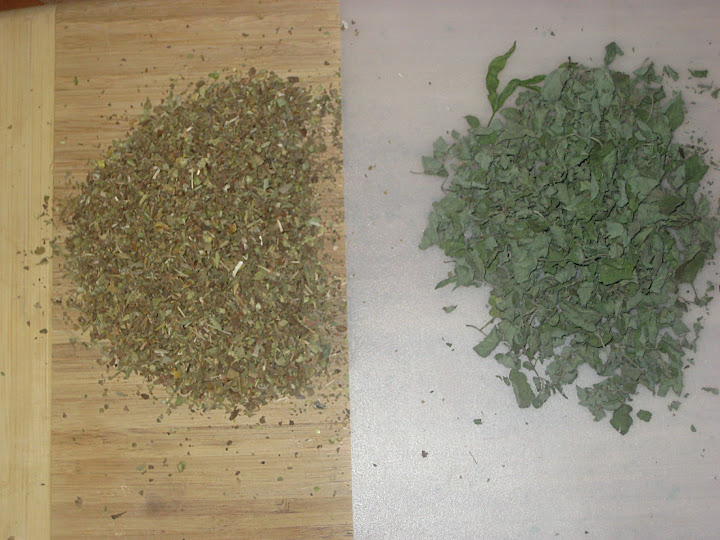
Unfortunately, you can't smell how amazing my dried parsley is, but here's the photo comparison of the store-bought parsley with my parsley.

Store bought parsley smells faintly of parsley, but mostly of "dried plant". Home grown parsley is the second strongest herb we grow. Saul put some in soup yesterday, and when I walked in the kitchen, that was all I could smell.

Continue reading ...

Thursday, August 14, 2008

Well, hello there

We found this in the garden.

That is a very LARGE tobacco hornworm. This explains why I kept finding half-eaten green tomatoes on the top of my plants. I think this one guy was doing all the damage. As big as he is, he was really hard to see. I only found him because he was ON the tomato I intended to pick.

I scoured the tomatoes, but found no others. We did have one last year, but it was smaller and covered in wasp eggs (yay for companion gardening!) I planted flowers that attract a particular wasp that kills these worms, and with the exception of this guy, it seems to be working.

He's nearly ready to become a moth, so I didn't have the heart to kill him. I just put him on the other end of the yard with a pile of fallen green tomatoes that he could eat for a day or two.

Continue reading ...

Monday, July 28, 2008

Apartment composting

Let it be well understood that I have not tried any of the following mechanisms myself...

So, without your own happy compost pile, this seems like a pretty hard problem. From what I understand, throwing food scraps in the garbage does not allow them to degrade. They get put in a rather toxic dump where any insects can't really survive well, and there may not be enough oxygen or water to support the bacteria needed.

I've heard of two things you could try if you can't have a compost pile or a fancy compost bin:

In-ground composting
Under this method, you use a kitchen container (like this one) to store scraps for a few days. Then you go outside, anywhere, and dig a hole. Dump in your scraps, cover back over with dirt, and let it be. Bugs will do the rest.

This is supposed to be ideal for people with small yards, bad soil, or home associations that don't allow composting. It's also a great way to make the soil better with little work. If you're in a small apartment building, I bet you could just do this on the property and no one would care.

If raccoons become a problem, apparently covering over the space with a brick for a week works. Then you just move the brick each week when you dig the new hole.

Vermicomposting
This is worm-based composting. As in, you have a box, and you keep pet worms. You feed them all your food scraps and you provide them with a nice "bedding" material. If done properly, there isn't supposed to be any smell, and the resulting soil is extremely fertile and would be good for houseplants. More info about doing this in an apartment!

Honestly, I'd get too busy and forget about them. Maybe they aren't much work, but given how the litterbox smells right now, I don't think I could handle a box of worms...if someone tries this out, let me know! I'm curious whether this is actually doable and reasonable. Given the number of sites that turn up when I search for "worm bin", I suppose quite a few people are going for it, so maybe it's easier than I'm expecting.

Continue reading ...

Composting

Lizzi asked about composting. I'll post first about what we do, and then about some things I've heard you can do in an apartment situation. So here's my compost mechanism:


What do you mean you don't have a 120 gallon aquarium with a 5 pound garbage disposal with claws and a fondness for biting fingers?

Ok, in reality, Terabyte gets first pick of the veggie scraps, but the rest go into the compost pile. We have a little can in the kitchen which stores the scraps up for a few days, then we dump it outside. This is particularly handy in winter when we don't want to go outside everyday to add scraps.


You'll notice we're pretty lazy composters. No fancy rotating bins for us. No adding worms, no thermometers and water gauges. We dump stuff on, and fancy that, it composts. My neighbor seemed kinda surprised by this concept. :) Once in a while, we turn it, and when we water the garden, we add some water to the pile. Based on the size of our worms, we're doing ok.

To prevent it from smelling, we just add only veggie scraps and yard waste. As long as you don't add any meat or sauces or anything beyond plant matter, it's fine. There's a fair amount of dirt in there, and we turn it every couple of weeks to get the scraps to the inside of the pile and bring the dirt on the top.

We also try to keep a 50-50 mix of greens(fresh plant matter) to browns(dried leaves). Supposedly this is a good balance for soil, but I think it also prevents it from smelling.

Continue reading ...

Monday, July 21, 2008

Awesome herbs

As I mentioned, herbs are everything. Based on the results from my garden, here is the "top list" of herbs that produce well, taste good, and are easy to grow (especially in PA).

Oregano
This is a great herb. It has taken over the pot we planted it in. It makes pretty white flowers. We use it in everything from salad to pasta. It comes back every March, and it grows prolifically until the first hard frost. It also dries well so we have enough for the winter. I have started adding oregano to everything I cook.

Chives
Chives are another plant that come back every March with a vengeance. These things put up shoots when there's still snow on the ground. I started 6 chive plants from seed. Now I have 9 large plants that are 18 inches tall and 6 inches in diameter. They just keep growing. They also put up lovely flowers which are also edible (I have blue, pink, purple, and white). Again, this tastes good in everything from salad to pasta to potatoes. You can harvest pretty hard, and they just come right back. They thrive on neglect. They even flowered when they were in full shade and clay soil.

Parsley
Good old Italian parsley. Unfortunately, it's an annual, but it does produce a lot of leaves. There is a clear difference between home-grown and store-bought parsley. It is extremely strong when grown at home. Be careful with how much you use.

Rosemary
I couldn't start rosemary from seed, and it definitely does better in sun. Not as prolific in PA, but it is a woody perennial and gets bigger every year. We discovered (by accident) that if you pile it over with leaves in November, the plant will remain green underneath. Just uncover it again in April.

Basil
Another annual. This one needs full sun. It's definitely the most finicky of those I've lsited, but hey, everyone can use basil. We also learned that they don't like too much water. Ours nearly drowned this year.

Cinnamon Basil
What's better than basil? Cinnamon basil. Nice spicy scent. Smaller leaves, but the plant is bushier and tolerates part-shade.

Mint
Mint thrives on neglect. At our house, it grows in a bed with terrible soil, and we never water it. Do NOT plant this in a garden, as it will take over! Pot it or put it in a bed by itself (ours grows under the privet hedge). I don't really use it that often, beyond adding it to water, but it does grow well.

We also have lemon thyme, dill, cilantro, and sage at home, but these haven't done quite as well as the above plants.

Continue reading ...